
Valencia's Disneyfication
.png)
“It freaks me out what Valencia is becoming” is the title of a reddit post I quickly come across as I research the city’s development of the past couple of years. Valencia no longer seems to belong to its citizens, as Airbnb, Starbucks, and about 6 million tourists every year take over. Is Valencia turning into a theme park?
It’s a warm summer night when I meet a good friend of mine in a lively neighbourhood in Valencia. I am here for a week, while he has spent the past months here as an Erasmus Student. We haven’t seen each other in years and have a lot to catch up on. When asked about living here, he says he loves it. “The city has everything”, he explains: “There’s the historic city centre, the Tulia Park is great for sports or spending free time, you have two universities and, of course, the beach is not far.” To me it’s easy to understand why he likes it here. And clearly he is not the only one. In 2024, Valencia registered more than six million booked nights in tourist accommodations. In the past couple of years the city became one of the biggest tourist destinations in Spain.The rising number of visitors did not remain without consequences. Before coming to Valencia, I read about several anti-tourism protests online. Citizens report an increase in rent prices along with other negative consequences.
In order to understand more deeply how this has affected the city, I meet Luis del Romero Renau, who works at the department of Geography at the Universitat de Valencia and has been interested in this matter both personally and academically. We speak in his office, which is full of maps and has a large bookshelf that showcases his many interests. His language skills are impressive, as he not only speaks Spanish and English, but also German and French.
.jpg)
He tells me that in the early 2000s, Valencia tried hard to follow in Barcelona’s footsteps, through hosting a couple of major events, like a formula 1 circuit, with mediocre success in becoming a tourist destination. But this changed rapidly when Ryanair and Airbnb came along and made European Tourism a lot easier and cheaper than it used to be. Having the reputation of being Barcelona’s little sister without the crowds, Valencia quickly became a destination of interest. According to Visit Valencia, a non-profit foundation, the number of overnight stays jumped up by 10% in 2024 compared to the year before. Additionally, the city has experienced more and more cruise ship tourism. In 2024, more than 770.000 people embarked at Valencia’s port, compared to 435.600 in 2019. Valencia is by far not Spain’s biggest hotspot for tourism, but it sped through the process of getting there, much faster than other popular destinations. “The problem is that the process of touristification that Barcelona experienced over 25 years, Valencia went through in just 5“, Luis explains.
“The problem is that the process of touristification that Barcelona experienced over 25 years, Valencia went through in just 5.“
With little time and space to adapt for accommodating all of these tourists, the consequences are easy to imagine. Big companies used the spaces that already existed and, if necessary, drove locals out of their homes. Lucky for them that Spain barely has any regulations for landlords. Contracts can be terminated without giving any reason and rent can be risen according to the landlords’ taste. At the same time, regional policies allowed entire Valencian buildings to be bought by companies. Luis has experienced this first-hand. He used to live in Ruzafa until his contract was suddenly terminated. Although there are currently no official numbers on this issue, Luis is not alone in his experience.
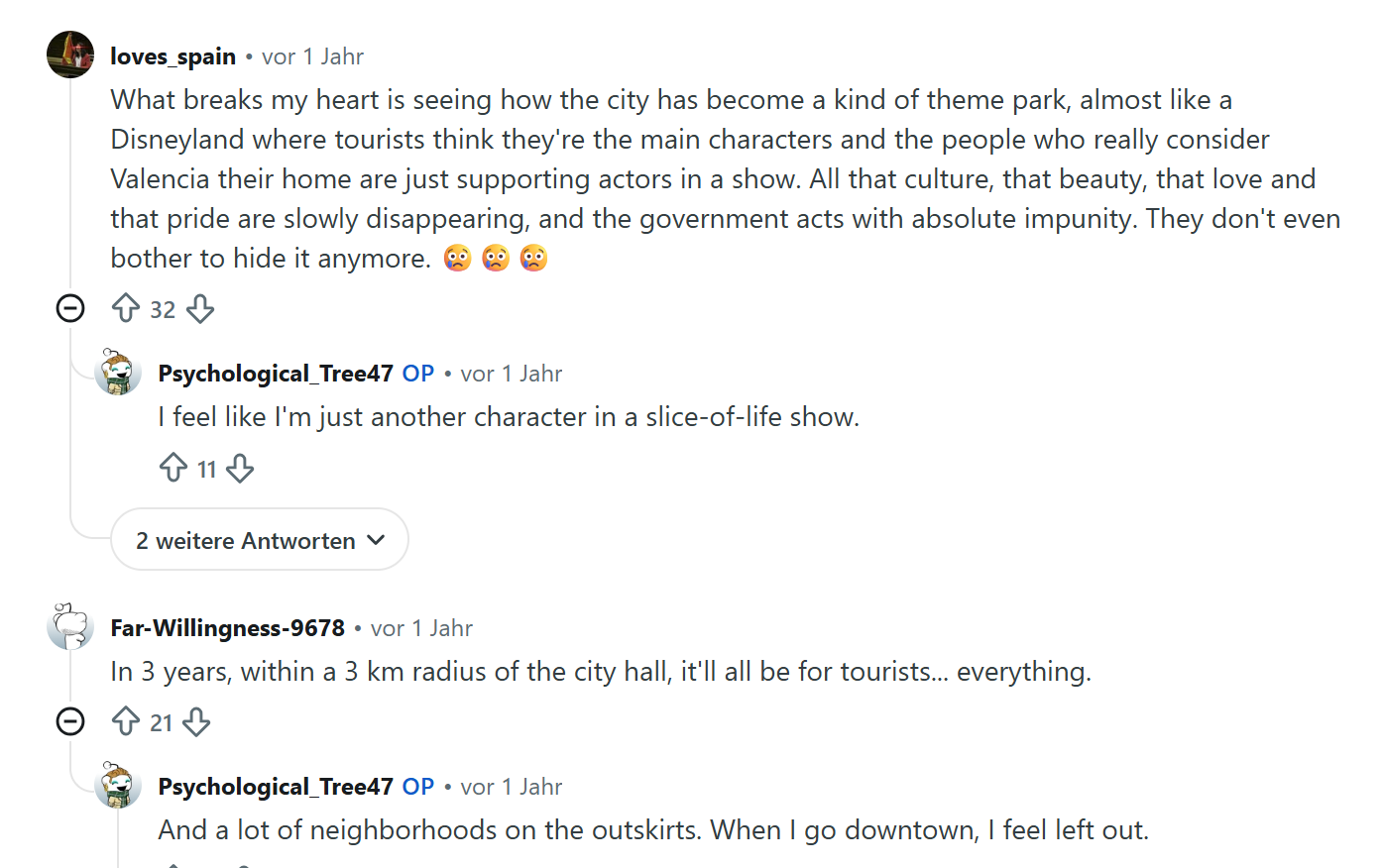
There are lots of reports to be found of people who went through something similar. When I read about the issue online, one of my first finds is a reddit post about how the city has changed for the worse. Local bars have been replaced by trendy cafés, creating co-working spaces for digital nomads, and international chains have taken over the storefronts in the city centre. “What breaks my heart is seeing how the city has become a kind of theme park”, one of the users states. This process is so common by now that there even is a term for it: Disneyfication. It describes the transformation of a place into something that feels beautiful, safe and familiar, usually in the interest of big companies for commercial purposes. Often, local authenticity is sacrificed in the process.
This change can be traced back through Google Streetview, which acts as a virtual time machine, capturing specific moments. Exhibit A: 38 C/ de Pelai, Ruzafa. Where a bubble-tea shop stands now, there was an empty garage just a year earlier. Rewind to 2018, and you‘ll find the Jerusalem Neighbourhood Association in its place. Exhibit B: Carrer de Colón, Old Town. The corner hosted an Algerian restaurant in 2019, then Frankie’s Burger Bar in 2022, and now, in 2024, a Starbucks. And talking about Starbucks: In 2024 they also opened another branch in the former spot of the Casa de los Caramelos, a local business with a long tradition, in 20 C/ de Xàtiva, close to the Train Station Norte.
Cities change constantly. And not everything about Disneyfication is inherently negative. For example, the process often creates pedestrian zones, as walkability is prioritized. Safety and cleanliness are a common side-effect, as well as the increase of revenue and the creation of new jobs. The preservation of local sites and artifacts is another important factor, as these are the things that are highly marketable and therefore beneficial to investors.
But the cost for this remake is high. In Valencia, it is currently the working-class that has to face the realization that they are not wanted in certain areas anymore. The city centre caters to touristic interests rather than being enjoyed by actual citizens. And the new jobs created by the industry are often paying employees poorly to maximize revenue, which goes to international companies instead of local communities.
“Who wants to live in a theme park?”
I think about all of this as I walk back to the hostel with my friend at night. Suddenly, he pulls me aside and points to a cockroach crossing our path. I shiver at the sight. But maybe they serve as a reminder that Valencia, for all its polish, is still a living, messy city. It does make me wonder: What kind of city would I like to experience? When we look at Disney’s fairytales, it becomes clear that they usually feature a very specific, narrow ideal. Can you name a Disney fairytale that features a disabled character, a protagonist over 25, or any meaningful representation of queer persons? The answer is likely no, as marginalized communities take up little space in Disney’s fairytale world. Disneyfication leaves little room for individuality and turns a city into an expensive as well as overcrowded one. Personally, I think that fairytales were never meant to be so heavily influenced by corporations, but have always been kept alive by the people who told, and by doing so constantly re-invented them. Just as cities are shaped by their citizens and guests. But I also don’t think that the consciousness of the individual traveller can be solely relied upon. In the long run, regulations are going to be needed in order to ensure that Valencia’s future story is told by its citizens.
Text & Photos : Paula Freese